When Air Becomes an Actor: A New Materialist Reading of Urban Inequality in Jakarta

Arfiqni Dinal Maula
What happens if we stop seeing air pollution as only an “environmental problem” and start seeing it as part of social life, something that decides who can live healthily and who cannot? In Jakarta, bad air has become a normal fact of daily life: the red numbers on AQI apps, masks that never come off, and short breaths that people treat as something “natural” in a big city. But people rarely ask how pollution affects different groups in different ways, especially those who have no choice about where they live or how they access healthcare. From a new materialist perspective, pollution is not a passive background. It is a material force that shapes everyday experiences, shows power relations, and marks structural inequality. The question is no longer only “how bad is Jakarta’s air,” but how the material itself “speaks” about who carries the heaviest burden of modern life.
New materialism appears as a response to modern ways of thinking that place full agency on humans, as if the material world is just passive matter waiting to be used. Thinkers like Karen Barad and Jane Bennett argue that matter has its own force: it affects, shapes, and even limits human actions. Barad’s (2007) idea of “intra-action” rejects the strict separation between human and non-human; both are always connected and create each other’s conditions. Bennett’s (2010) concept of “vibrant matter” says that materials have their own vitality that must be taken seriously in social analysis. With this perspective, air pollution is not only the result of industry or cars, it becomes a material actor that influences health, mobility, and social vulnerability. This helps us see that environmental injustice is produced not only by policy but also by how material dynamics work together with social structures.
We can see environmental justice clearly when we look at how pollution operates unevenly across Jakarta. Two children can breathe the same “Jakarta air,” but their intra-action with pollution is completely different: a child living in a low-income housing block like Rusunawa Cipinang inhales PM2.5 almost without pause, while a child in Menteng breathes air that has been filtered many times. Pollution here is not a neutral presence; it follows the lines of inequality, enters some lungs more deeply, stays longer in some bodies, and builds risk over time. As Michelle Murphy (2006) explains, toxic vulnerability is never neutral; it is formed and reinforced by unequal social structures from the beginning.
This inequality is tied to modern thinking that separates humans from the material world, as if we stand outside nature and can control it freely. This dualism makes it easy to see pollution as just a “leftover” of development, rather than a material actor that shapes social life. Bruno Latour (1993) criticizes this separation by showing that modernity creates the illusion that humans and non-humans live in different spheres, when in fact we always live in networks that connect and influence each other. In this sense, Jakarta’s pollution is not just caused by industry or cars, it is part of a material network that shapes who stays healthy, who becomes vulnerable, and who pays the real cost of development. This logic of separation and exploitation is not new; it is echoed in ethical warnings across traditions that urge restraint toward the Earth. In Jakarta, the air itself shows that when matter is treated as if it can be endlessly exploited, the first to suffer are always those who are structurally pushed away from access to clean and safe living spaces.
Jakarta’s air pollution is often framed as a technical problem: check AQI, wear masks, reduce private cars. This sounds like a solution, but it actually shifts responsibility from industries and the state to individuals, especially those who have the least choice. Data shows that pollution is not just about personal lifestyle. A 2025 study estimated that more than 10,000 deaths and thousands of hospitalizations every year in Jakarta are caused by poor air quality, with children being the most affected group (Ginanjar et al., 2025). Another study in Asemka found that street vendors are exposed to far higher levels of PM2.5 than higher-income groups, showing that toxic risk follows social inequality (Sembiring, 2020). From a new materialist view, polluted air is not a neutral substance; it moves, sticks, and works harder on bodies that are already marginalized. That is why mitigation cannot stop at individual moral advice. It requires industry accountability, strong regulation, and a fair distribution of clean living spaces. Without this, we only extend the cycle of exploitation and matter will continue to “speak” through toxins, illness, and death.
What people rarely discuss is how policies themselves strengthen the material force of pollution. Pollution does not only follow the wind; it follows political decisions: weak industrial permits, development without green space, and transportation systems that depend on private vehicles. In Jakarta, for example, research by the Centre for Research on Energy and Clean Air (2023) shows that 70% of PM2.5 exposure comes from sources that the state can control, such as transportation, coal power plants, and manufacturing industries. This means matter does not act alone. It is pushed, concentrated, and allowed to accumulate through policies that protect economic interests more than citizens’ right to breathe. When these decisions are made without considering who is most vulnerable, pollution becomes a tool of social selection: those who can protect themselves survive, while the rest must accept risk simply because of where they were born and where they live.
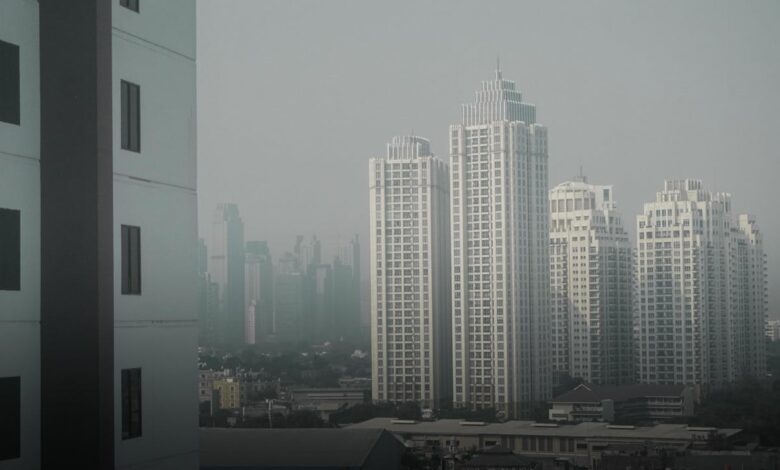
In the end, Jakarta’s pollution reminds us that the material world is never fully under human control. It moves, settles, and enters certain bodies more quickly than others, and through its silent presence, it shows who is treated as worthy of a healthier life and who is left to breathe danger. As long as we treat matter as passive, something fully obedient to human logic, we will continue to miss the signs this city keeps giving us: children’s coughs, the permanent grey sky, and death counts that never fall. Maybe the real question is not only how to improve air quality, but whether we are willing to change the social system that makes some people the first home for the toxins of modernity.
References
Barad, Karen. Meeting the Universe Halfway: Quantum Physics and the Entanglement of Matter and Meaning. Durham, NC: Duke University Press, 2007.
Bennett, Jane. Vibrant Matter: A Political Ecology of Things. Durham, NC: Duke University Press, 2010.
Syuhada, Ginanjar, Adhadian Akbar, Donny Hardiawan, Vivian Pun, Adi Darmawan, Sri Hayyu Alynda Heryati, Adiatma Yudistira Manogar Siregar, Ririn Radiawati Kusuma, Raden Driejana, Vijendra Ingole, Daniel Kass, and Sumi Mehta. “Impacts of Air Pollution on Health and Cost of Illness in Jakarta, Indonesia.”
International Journal of Environmental Research and Public Health 20, no. 4 (2025): 2461. https://pmc.ncbi.nlm.nih.gov/articles/PMC9963985/.
Latour, Bruno. We Have Never Been Modern. Cambridge, MA: Harvard University Press, 1993.
Murphy, Michelle. “Indoor Pollution at the Encounter of Toxicology and Popular Epidemiology.” In Sick Building Syndrome and the Problem of Uncertainty: Environmental Politics, Technoscience, and Women Workers, 81–110. Durham, NC: Duke University Press, 2006.
Sembiring, Elsa Try Julita. “Risiko Kesehatan Pajanan PM2.5 di Udara Ambien pada Pedagang Kaki Lima di Bawah Flyover Pasar Pagi Asemka Jakarta.” Jurnal Teknik Lingkungan 26, no. 1 (2020): 101–120.
Centre for Research on Energy and Clean Air (CREA). Jakarta Air Quality Assessment Report. Helsinki: CREA, 2023.
Arfiqni Dinal Maula is a graduate student in the Center for Religious and Cross-cultural Studies (CRCS), Graduate School, Universitas Gadjah Mada