OWW As the Third Wheel: MUI Between Cat Wedding Rituals and Land Prosperity

Raden Safinatul Aula Wiji Kinasih
“If religion and culture cannot be combined, then Islam wouldn’t have existed in Indonesia.”
When Cat Wed, Nature Rejoices
Since ancient times, rituals have often involved not only humans, but also animals, supernatural forces, and the natural world. In Pelem Village, Tulungagung Regency, an inclusive tradition known as Manten Kucing, the cat wedding ritual, has long been performed to invoke rain and prosperity.
The ritual is said to date back to the colonial period, around the 1870s, when Eyang Sangkrah, a village leader, first conducted it. According to local accounts, Eyang noticed that after bathing her cat, Condromowo, at the Coban Kromo spring, the rain fell. Later, during another severe drought, Demang Sutomedjo reportedly received a spiritual revelation instructing him to repeat the ngadus kucing (cat bathing) ceremony, after which rain once again fell. Since that time, the people of Pelem Village have preserved the ritual as a customary practice for invoking rain.
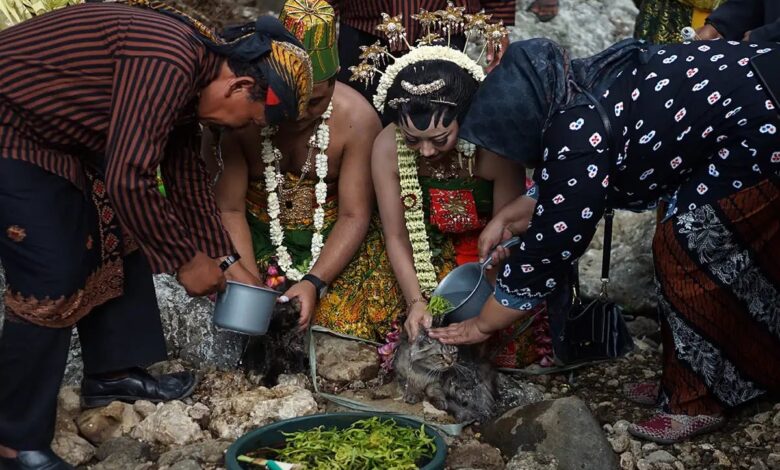
What began as a simple act of bathing cats gradually developed into a symbolic manten kucing, or cat wedding ceremony. The ritual now involves more than merely washing a pair of cats at Coban Kromo. The selected cats must come from the Bangak and Sumberejo hamlets, symbolizing participation from across Pelem Village. The procession typically starts at the village head’s office, with villagers joining in a collective celebration. Only the village head or descendants of Demang Sutomedjo are permitted to bathe the cats, underscoring the ritual’s ancestral lineage. In some areas, the ritual opens with the syahadat and marriage prayers before the bathing takes place, reflecting respect for ancestors and reverence for both religious elements and inherited tradition. The ritual continues with a communal thanksgiving near Coban Kromo, where the cats are placed on the laps of a man and a woman, symbolically positioned like a bride and groom, while villagers offer prayers for rain. The ceremony concludes with Tiban, a rain-invoking performance in which participants whip one another with palm fronds, embodying a dramatic plea for rainfall.
Even Cat Can’t Escape the Religious Blasphemy Charge
Unfortunately, many still continue to view the ritual from a subjective standpoint, hastily judging it as heretical or shirk. Some misunderstand the practice, assuming that participants pray to a cat for rain instead of to God. In 2010, critics accused the “cat wedding” ritual of defaming Islam, arguing that its incorporation of Islamic elements and prayers turned it into a form of mockery.
For instance, the deputy chairman of the Indonesian Ulema Council (MUI) branch in Tulungagung questioned the government’s support for the ritual, stating: “How could the government support a practice that offends Muslims and resembles polytheism? How could a cat be married like a human being married in Islam, especially accompanied by the ijab qabul and hadrah prayers?” Similarly, the caretaker of the Al-Fatah Mangunsari Kedungwaru Islamic Boarding School argued that while cultural development is permissible, religion should not be mixed with cultural expressions, describing the ritual as tantamount to insulting Islamic scholars.
Finally, the Secretary of the MUI, Abu Sofyan Sirojuddin, stated that the local government had ignored prior warnings from the council, as outlined in their official letter (Letter No. 115/DP-Kab/MUI-TA/2010). These objections eventually led to a ban on holding the ritual publicly.
To Reconcile the Ritual of Cat Marriages and the Well-Being of Land
This essay argues that the ritual is not merely a practical means of asking for rain, but also embodies deeper cultural and spiritual values. Viewed through the lens of new animism, it reflects an understanding of relationality between humans and the more-than-human world. In line with the ideas of Linda Hogan, who emphasizes that animals, plants, and land are equal and part of an extended kinship network, the ritual can be understood as expressing a worldview in which humans do not stand above nature, but exist in reciprocal relationship with it.
“Traditionalist Dennis Martinez calls our work in the world kincentric. The cosmology and relationship to nature is one of equality. …when we accept the long conventions of respect for the world, for the animals as beings equal to us, and for living in a way that is conscious of the lives of plants and endangered insects, ….”
In a world where humans and animals are equals, rituals are a shared effort to support their common friend: the land. This perspective emphasizes mutual survival and respect. Since both people and wildlife need fertile ground to survive, they “pray together,” asking higher powers for the rain needed to heal the soil. It is a cycle of give-and-take where every being plays a role in sustaining the others.
By dismissing the ritual as “un-Islamic,” institutions like MUI Tulungagung reveal a limited, singular notion of religion. They are stuck in what Escobar calls the “One-World World,” a viewpoint that refuses to see the validity of local ontologies. Critics argue that rain should only be sought through formal prayer, that is sholat istisqa, yet they miss the beautiful theology at play: a communal plea to God alongside our animal kin. Furthermore, the argument that religion and culture must remain separate is fundamentally flawed. If Islam had not embraced Indonesian culture, it would not exist here today. We must open our eyes to the pluriverse—a reality where diverse spiritualities fit together rather than cancel each other out.
References
Ardhianto, Frandhica Wahyu, Wahono Widodo, and Nurul Istiq’faroh. “Tradisi Arak Manten Kucing Di Desa Sumberejo Kabupaten Malang.” Jurnal Ilmu Sosial dan Budaya Indonesia 2, no. 2 (December 2024): 125–31. https://doi.org/10.61476/z2ec1y38.
Asiyah, Nur, and Yohanes Hanan Pamungkas. Pergeseran Fungsi Ritual Manten Kucing Di Desa Pelem Kecamatan Campurdarat Kabupaten Tulungagung Tahun 2001-2013. 5, no. 1 (2017).
Darisandi. “Temanten Kucing.” Perpustakaan Digital Budaya Indonesia, 2014. https://budaya-indonesia.org/Temanten-Kucing.
Escobar, Arturo. Designs for the Pluriverse: Radical Interdependence, Autonomy, and the Making of Worlds. New Ecologies for the Twenty-First Century. Durham: Duke University Press, 2018.
Hakim, Luqman. “Manten Kucing Ritual Memohon Hujan.” 2022. https://mediaindonesia.com/weekend/535321/manten-kucing-ritual-memohon-hujan.
Harvey, Graham, ed. The Handbook of Contemporary Animism. London New York: Routledge, Taylor & Francis Group, 2014. https://doi.org/10.4324/9781315728964.
Muasmara, Ramli, and Nahrim Ajmain. “AKULTURASI ISLAM DAN BUDAYA NUSANTARA.” TANJAK: Journal of Education and Teaching 1, no. 2 (August 2020): 111–25. https://doi.org/10.35961/tanjak.v1i2.150.
NU Online. “MUI Tulungagung Kecam Festival.” 2010. https://nu.or.id/warta/mui-tulungagung-kecam-festival-quotmanten-kucingquot-ulCAu.
Rianda, Rizky Tasih. “Budaya Manten Kucing Dalam Perspektif Hukum Islam (Studi Kasus Di Desa Pelem Kecamatan Campurdarat Kabupaten Tulungagung).” Institut Agama Islam Negeri (IAIN) Tulungagung, 2015.
Santaka, Krisna Arandiya. “Nilai Budaya Dan Implementasi Pancasila Pada Tradisi Manten Kucing Di Kabupaten Tulungagung.” PKn Progresif : Jurnal Pemikiran dan Penelitian Kewarganegaraan 19, no. 1 (August 2024): 12. https://doi.org/10.20961/pknp.v19i1.86861.
Raden Safinatul Aula Wiji Kinasih is a graduate student in the Center for Religious and Cross-cultural Studies (CRCS), Graduate School, Universitas Gadjah Mada