Relational Multispecies World: Listening to Bees, Chickens, and Humans in Bayan

Arfi Hidayat
The relationship between Islam and cultural institutions in the Bayan Indigenous Community is often perceived as two opposing entities, especially since Dutch colonialism and the subsequent strengthening of the discourse of modernization during the New Order era, which structured knowledge in a binary manner (religion versus custom). Such narratives view customary practices as “deviating” from faith, as if traditions were unchanging, never negotiated, and not the creative residue of past civilizations. In fact, the empirical experience of the Bayan people reveals an intense sense of ethics, reciprocity, and responsibility (Maarif, 2023), in which nature, animals, and non-human entities are acknowledged to have agency within the framework of tawhid.
Everything and its contents—such as nature, animals, plants, supernatural beings, humans, and others—are considered to be living beings that coexist on earth. In their practice, their relationship with the land, forests, animals, and other earth beings is not merely a utilitarian one, but rather an ethical relationship that considers the morality of others as subjects; thus, their relationship is full of responsibility and compassion.
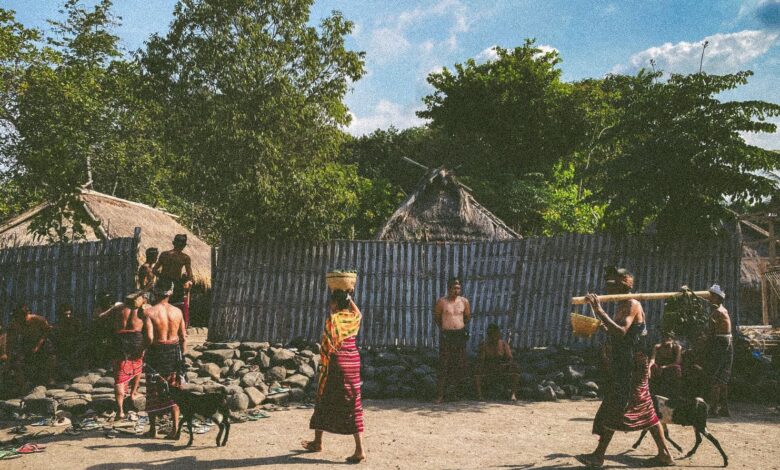
The Bayan Indigenous Community, located in Bayan District, North Lombok, is part of the Sasak people, who maintain a living customary system grounded in musyawarah (gundem). Their customary governance is organized through two interconnected institutions: the pemekelan karang bajo, which oversees social-material affairs, and the pemekelan loloan, which manages religious-spiritual matters. Their ritual life includes adat gama—such as the Maulid Adat, Lebaran Tinggi, and Lebaran Pendeq—as well as adat luir gama, which safeguards ecological balance, with the gawe alif marking the culmination of the ritual cycle. This socio-cosmological structure forms the setting in which human–non-human negotiations unfold in everyday life.
I reflected on agency in the culture of the Bayan indigenous community through my findings when I met them; I was told about two practices that still exist in Bayan: (1) the practice of asking permission from the bees before taking honey; (2) the traditional Maulid ritual, which requires a “volunteer chicken” to be slaughtered. It reflects the multispecies ethics in relational belief of the community.
Permission to the Bee: Intra-action as the Multispecies Monotheism Ethics
First, as if a traditional leader was telling me a story, he said that he had witnessed with his own eyes the elders and the perumbaq (traditional guardians of the forest) sitting reverently in front of the tree, greeting the colony as if greeting fellow creatures, then reminding them of the covenant of love between humans and animals under God’s power. They waited for a sign. If, after three requests for permission, the bees did not emerge from their hive, the elders would leave and look for another hive.
The sign here was not merely a symbol read by humans. It was an interactive event born from the intertwining of prayer, time, the atmosphere of the forest, local knowledge, manners, and the response of the bees as a non-human agency in a multispecies world.
According to Barad (2007), material and discursive apparatus or practices configure what can be present as consent or refusal. Prayer and etiquette are not accessories in rituals, but part of the apparatus that both opens up and limits the possibilities for action. In Bennett’s (2010) thinking, the vitality of bees is evident in the rhythm of their coming and going from the hive, their swarming patterns, and their sensitivity to human presence. All of this gives rise to thing-power that calls for an ethical response. Bees become co-determinants in the process of honey collection. Agency is not monopolized by humans.
The practice of waiting for signs and accepting rejection radiates the ethics of monotheism: an ethic that refrains from coercion and recognizes that every creature is a sign of God’s power. Human actions in the forest do not stem from a desire to plunder, but from a willingness to ask permission. This ethic reminds us that ecological relationships cannot be understood as relationships between dominant subjects and passive objects, but rather as interconnected encounters.
A Sincere Chicken
In the traditional Maulid ritual in Bayan, grilled chicken can only come from chickens that “volunteer themselves.” It sounds a little silly, but as I was informed, the Lokaq (the traditional leader who conducts the ritual) opens the coop door, sits calmly, and then asks softly, “Come on, who is sincere?” If a chicken approaches and jumps onto his lap, that is the sign. Phenomenologically, this moment challenges the modern assumption that animals are objects without will. However, in Bennett’s (2010) perspective, the chicken presents vibrant matter. Its bodily response, approaching steps, and calmness without coercion demonstrate a vitality capable of influencing ritual decisions.
From Barad’s perspective (2007), “sincerity” is not a choice that stands alone, either on the part of humans or animals, but rather the result of intra-action. This phenomenon arises from the intertwining of the ritual atmosphere, the language used, body gestures, the structure of the cage, the rhythm of the maulid, and the horizon of tawhid that frames the action. “Sincere chickens” are a phenomenon that can only arise within the maulid apparatus. Outside of this context, the act of jumping onto someone’s lap would be interpreted very differently.
The Actor Network Theory approach stems from the idea that actions never originate from a single agent, but from a network of interconnected human and non-human actors. Within this framework, chickens, lokaq, coop doors, gentle questions, norms of sincerity, maulid calendars, and communities that recognize these signs work together as actors that condition events to occur. There is no single center of authority. There is only a network that allows an ethical moment to emerge from distributed relations (Latour, 2005).
Here, idup sopoq (one life) manifests as material and spiritual ethics. Actions present themselves as a language of the world that can be read by monotheistic humans. The decision to slaughter is not a form of domination, but a negotiation with animals that are recognized as having agency. Therefore, the ritual does not reduce animals to tools, but is conditioned by and so recognizes ontological contacts of relational actors (animals and humans) as fellow divine beings. At the same time, it accepts the Sharia law on the permissibility of slaughter, but places it within the framework of respecting life that manifests itself.
Reflection from the Bayan Indigenous People
From Bayan practices, we learn that multispecies communication is both possible and real, rooted in a cosmology shaped by tawhid (Islamic monotheism). Read through New Materialism, these encounters are not projections of human intention but intra-active events where sensations, gestures, and rhythms are produced together. Humans, bees, chickens, trees, and ritual settings become participants in one shared ontology.
In this sense, communication across species is not a metaphor but a reality. The world is composed of many languages expressed through taste, movement, ritual, and material presence. Bennett’s (2010) idea of vitality can be understood here as a divine emanation, where material life reflects sacred life. Non-humans show agency by offering signs of “gift”, withholding consent, or responding to human approaches. It affirms that all beings participate in a relational, unified creation and must be approached with attention, humility, and respect.
In this framework, immanence and transcendence do not negate each other. Living materiality actually presents transcendence as an ethic of shared destiny. Agency spread across entities is in line with the prohibition against imposing needs to the point of destroying the order of life. Barad (2007) views ethics as something that is formed together with the material and discursive world. Idup sopoq (one life) echoes this view, while emphasizing that ethics cannot be separated from tawhid. Both meet in the same commitment, namely to refrain from the desire to dominate the world and choose to negotiate actions together with a world full of agency.
The Bayan teaches self-restraint as both a spiritual and ecological discipline. Taking honey with the bees’ permission or slaughtering chickens that volunteer themselves shows that small daily decisions are always measured based on their impact on the web of life. This approach goes beyond technical conservationism. It makes transcendence a concrete ethical compass, not a metaphysical abstraction. Multispecies communication, in this horizon, is not merely an ecological possibility, but part of the practice of tawhid that respects life as a community of beings who care for one another.
Reference
Barad, K. (2007). Meeting the Universe Halfway: Quantum Physics and the Entanglement of Matter and Meaning. Durham, NC: Duke University Press.
Bennett, J. (2010). Vibrant Matter: A Political Ecology of Things. Durham, NC: Duke University Press.
Latour, B. (2005). Reassembling the Social: An Introduction to Actor-Network-Theory. Oxford, UK: Oxford University Press.
Maarif, S. (2023). Human (Relational) Dignity: Perspectives of Followers of Indigenous Religions of Indonesia. Religions, 14(7). https://doi.org/10.3390/rel14070848
Arfi Hidayat is a graduate student in the Center for Religious and Cross-cultural Studies (CRCS), Graduate School, Universitas Gadjah Mada