CALL FOR ABSTRACTS
The 8th International Conference and Consolidation on Indigenous Religions (ICIR)

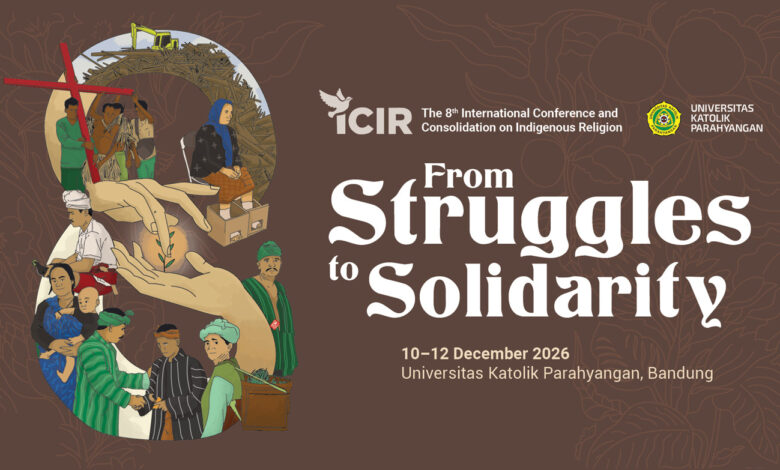
From Struggles to Solidarity: Interconnected Movements for People’s Sovereignty
December 10–12, 2026
Universitas Katolik Parahyangan, Bandung, Indonesia
Background
Systems of governance and development intended to organise societies, protect citizens, and promote well-being are increasingly causing social, political, economic, and ecological instability. Vulnerable communities are often the most affected. The erosion of the social contract leads to widening inequality, exclusion, and the digital divide, marginalising communities. Authoritarianism, corruption, and digital surveillance make democratic participation difficult and risky. Economic systems prioritising GDP growth and profit undermine community well-being. Ecological degradation and climate injustice create new vulnerabilities, transforming environmental crises into humanitarian disasters.
Indigenous and local communities have developed diverse resistance, resilience, and survival strategies. However, many initiatives remain fragmented due to geographic barriers, unequal power relations, corporate strategies of division, and limited connections between grassroots CBMs and CSOs.
The 8th International Conference and Consolidation on Indigenous Religions (ICIR) aims to create a space for scholars, indigenous communities, activists, civil society organisations, and other stakeholders to share experiences, build connections, and explore pathways from local struggles to broader movements for People’s Sovereignty.
Conference Focus
The conference invites critical reflection on how diverse communities can move beyond isolated forms of resistance toward interconnected movements that strengthen people’s capacity to shape the social, political, economic, and ecological conditions that affect their lives.
The conference particularly encourages discussion of three interconnected processes:
- Horizontal Coalescing: Building networks among indigenous and local communities and movements to exchange knowledge, strengthen solidarity, share resources, and develop collective voices.
- Vertical Consolidation: Connecting grassroots movements with civil society organizations, legal institutions, advocacy networks, and policy-making processes to strengthen their capacity to influence public policy.
- Structural Transformation: Moving from fragmented “islands of resistance” toward interconnected movements capable of addressing structural inequalities and engaging with national, regional, and global challenges.
Conference Organizer
The 8th ICIR is organized by the Intersectoral Collaboration for Indigenous Religion (ICIR) “Rumah Bersama” in collaboration with Universitas Katolik Parahyangan Bandung, particularly the Center for Human Development and Social Justice (CHuDS), Pusat Studi Hukum Transnasional, and the Centre for Philosophy, Culture, and Religious Studies (CPCRS).
Call for Abstracts
The 8th ICIR invites abstracts for papers, presentations, and community-based contributions that critically examine indigenous and local struggles, movements, knowledge systems, and pathways toward People’s Sovereignty.
We particularly welcome contributions that connect academic research with the lived experiences, knowledge, and strategies of indigenous and local communities. Submissions may be theoretical, empirical, methodological, reflective, or practice-based, and interdisciplinary and transdisciplinary approaches are strongly encouraged.
Suggested Themes
Contributions may address, but are not limited to, the following themes:
- Indigenous and Local Strategies for People’s Sovereignty: Building Intergenerational Solidarity and Interconnected movements for People’s Sovereignty across generations and boundaries.
- Safe Democratic Participation in Authoritarian Contexts: Strategies for protecting civic space and democratic engagement
- From Micro-Resistance to Policy Change: Examining how local and community-based struggles can grow into broader movements and influence public policy through collaboration with civil society organizations.
- Ecocentric Well-Being, Energy Justice, and Extractive Development: Rethinking development beyond economic growth and resource extraction. Exploring Indigenous and local approaches to environmental justice, energy justice, and ecological well-being.
- Food, Land, and Water Sovereignty: Community rights, traditional knowledge, and sustainable resource governance
- Intersectionality and Human Rights Movements: Restoring the dignity and rights of vulnerable and marginalized communities
- Human Flourishing and Bodies at the Margins: gender, children, disability, and Indigenous and local perspectives on well-being, dignity, justice, and a meaningful life
- Dismantling the Digital Divide: Examining how unequal access to digital technology affects participation, social relationships, and community life. It explores ways to make digital spaces more inclusive and socially connected.
We welcome submissions from
- Scholars and researchers from diverse academic disciplines
- Indigenous and local community representatives
- Activists and movement organizers
- Civil society organizations and human rights advocates
- Religious and cultural leaders
- Students
- Practitioners and professionals working with vulnerable groups
Abstract Submission
Abstracts should clearly present the title, research or presentation question, main argument or focus, methodology or approach (where applicable), and key findings, insights, or expected contribution.
Abstract length : 150-250 words
Keywords : 3–5 keywords
Bibliography : 10 projected references
Language : English/Indonesian
Please submit your abstract through this link:

Important dates:
4 October 2026 : Deadline for abstract submissions
16 October 2026 : Notification of Abstract Acceptance
23 Oktober 2026 : Confirmation of Attendance (offline/online)
13 November 2026 : Full Paper Submission
10 – 12 December 2026 : Conference
Expected Contributions
The conference aims not only to facilitate academic exchange but also to contribute to the consolidation of movements and networks for People’s Sovereignty. The outcomes of the conference are expected to include:
- An Agenda for People’s Sovereignty: A collaborative roadmap identifying shared priorities and possible pathways for collective action.
- A Strategic Consolidation Network: An inter-community platform for knowledge, experience, solidarity, and resource sharing.
- Published Proceedings: Transdisciplinary contributions documenting indigenous and local resistance, movement-building, ecological justice, and restorative approaches to economy and well-being.
Join the Conversation
The 8th ICIR invites us to move beyond understanding struggles as isolated experiences and to ask how these struggles can become interconnected movements for justice, dignity, ecological sustainability, and People’s Sovereignty.
We invite you to bring your research, community knowledge, lived experience, movement practices, and critical reflections to Bandung and contribute to building connections between local struggles and broader movements for transformative change.
Notes:
- Only authors of selected abstracts will be notified. Authors may submit a maximum of 2 abstracts, with no more than 1 selected for oral presentation.
- Authors of selected abstracts will be invited to present their papers either in person or online via Zoom.
- Selected papers will have the opportunity to be published in a SINTA 2 accredited journal, following a peer-review process and compliance with the journal’s editorial standards.
Conference Fee
Conference registration is free of charge. However, in-person presenters must cover their own travel, accommodation, and personal expenses, as the committee cannot provide financial sponsorship for these costs.
Conference Abstract Template
Click here to download the conference abstract template.
Contact Person
Ikrana (0811-1040-108)